Vladimir V. Wiedemann
Modern Russia stands as one of the world’s leading military powers. According to Alex Karp, head of the IT company Palantir, Russians excel at warfare and possess an outstanding mathematical tradition—qualities that compel the world to recognize Russia as a technological superpower on par with the United States and China. This article explores the historical origins of Russian statehood, which, like its Anglo-Saxon counterpart, traces its roots to Old Norse traditions that are deeply intertwined with local, archaic customs. Both Russian and Anglo-Saxon statehood rank among the oldest in Europe, with histories that span more than a millennium; furthermore, the resilience of the Russian and Anglo-Saxon political orders shares common historical foundations. To understand the phenomenon of the Russian political order, we examine the history of Russian statehood and the semi-legendary figure of Rurik, whose descendants ruled a vast Eurasian empire—rivaled in size only by the British Empire at its zenith—until the early 20th century.
This material consists of two parts:
I. A detailed history of Rurik, his clan, and the Russian state.
II. The Rurikids from the perspective of historical scholarship.
I. The Rurikids and the Military-Political Traditions of Russia
Rurik (Old Norse: Hrœrekr, Rørik) is traditionally considered the founder of Russian statehood. According to the Tale of Bygone Years, a chronicle from the early 12th century, Rurik, with two brothers and an armed retinue of Varangians (Old Norse: váringr, “mercenary warriors,” also known as Rus’, Old Norse: rōþr, “rower”), arrived in 862 in the territory of Southern Karelia (today part of the Leningrad Oblast, Russia) and laid the foundations of local statehood.
Rurik initially settled in the territory of the Scandinavian trading post of Staraya Ladoga (Old Norse: Aldeigja, Aldeigjuborg), at the mouth of the Volkhov River (Old Russian: volkhv – magician-spellcaster), on the shores of Lake Ladoga, while his brothers Truvor and Sineus (Old Norse: Signjótr, Þórvarðr) settled in Izborsk and on Beloye Ozero. A few years later, Rurik moved two hundred kilometers south, down the Volkhov, to the city of Veliky Novgorod (Old Norse: Holmgarðr), making it the capital of a state that became known as Rus’ (that is, “the state of the Rus'” – Rurik’s armed retinue). Since ancient times, the territory of Rus’ has been called Garðaríki (Old Norse: ᚴᛅᚱᚦᛅᚱᛁᚴᛁ, Garðaríki) in Scandinavian historiography, meaning “country of cities” or “gards” (garð) – fenced forts. These were outposts founded by the Vikings on the banks of river trade routes. Among these, Russian historiography distinguishes two main routes: “the route from the Varangians to the Greeks” (i.e., Constantinople, Old Norse: Miklagarðr – the capital of the Greek Kingdom or Eastern Roman Empire, Byzantium), and “the route from the Varangians to the Persians” – along the Volga to the Khazar city of Astrakhan on the northern coast of the Caspian Sea and further on to Persia (also known as Iran).
Scandinavian sources also mention other cities of Gardariki-Rus’, such as Kyiv (Kœnugarðr), Polotsk (Pallteskja), Smolensk (Smaleskja), Suzdal (Súrsdalar), Murom (Móramar), and Rostov (Ráðstofa). Almost all of them arose from Scandinavian fort-settlements and were governed, like Greek (and later Hellenistic) city-states, by assemblies of free citizens. Princes (konungs), as military leaders, were also elected at a popular assembly (ting). This is how Rurik and his brothers were called to rule. The Novgorod and Pskov lands (which include Izborsk) remained republican territories until the 16th century. These territories were neither conquered by the Mongols nor tributary to the Horde. Free peasant communities remained, and the social structure resembled the Scandinavian way of life. Only their conquest by the Muscovite state, led by Ivan the Terrible, put an end to the old traditions.
In Norse mythology, Gardariki was considered a territory ruled by Odin’s descendants, beginning with his legendary son Sigrlami (or, in another version, Svafrlami), wielder of the sworn sword Tyrfing. He was killed by the berserker Arngrímr. In total, the Scandinavian sagas mention approximately 50 legendary rulers of Gardariki, and there is also a list of 10 historical kings of this country, beginning with the ruler of Aldeigjuborg (Ladoga), Ingvarr, identified with Rurik’s son, Igor. The uniqueness of the kings of Gardariki lies not only in their legendary descent from Odin, but also in their belonging to the berserker clan (berserkr) – bear warriors (literally, bear-skin wearers), renowned for their ability to enter a special trance state during battle, granting them insensitivity to pain, unprecedented endurance, and animalistic fury.
I would especially like to note that the Varangian kings who became Russian princes were not, for the most part, ethnic Germans, but rather descendants of Germanized leaders of the eastern Baltic tribes of Finno-Ugric and Baltic origin. The Tale of Bygone Years indicates that Rurik and his retinue arrived in Gardariki from overseas at the request of local leaders of five tribes, three of which were Finnish, while the other two were most likely descendants of Slavicized Balts (Krivichi) and those same Finns (Ilmen Slovenes).
The Rurik dynasty itself, according to Y-DNK tests of its modern representatives, has haplogroup N1a1a, historically predominantly found among Finno-Ugric peoples rather than among Slavs or Balts, who are closely related to the East Germans (R1a). Interestingly, the majority of men in the Novgorod lands (Northern Russia) belonged to haplogroup N1a1, as did a significant portion of men of Baltic descent (up to half or more), including the Lithuanian princes of the House of Gediminas (from the Baltic “striving for glory”) and the famous Baltic German princes, the Lievens (considered descendants of the Livonian leader Kaupo). The Baltic German barons, the Ungerns (“Hungarians”), trace their ancestral lineage back to the Finno-Ugric line.
The Vikings, as a corporation of sea robbers, accepted into their fighting squads anyone willing to fight on their side and adapt to their social institutions. The first written legal code of Ancient Rus’, the so-called “Russkaya Pravda” (Russian Truth) of Yaroslav the Wise (King Yaritsleif), is a version of Scandinavian law written in Old Russian, whose patterns governed the lives of the local population and its ruling Varangian (Russian) elite. Thus, it is quite possible that Rurik, a member of the local nobility, arrived in Staraya Ladoga not from Scandinavia, but from the Gulf of Finland or Lake Ladoga region.
But what is known about the history of Rurik himself and his ancestors? There are two main historical schools of thought examining this issue: Normanists and anti-Normanists. According to the former (and this is the almost official approach), Rurik was Scandinavian by origin, and possibly even a Skjöldung, related to members of the Danish aristocracy (he was also the Danish Rurik). Rurik arrived in Rus’ from Roslagen, a Swedish province on the Baltic coast near Stockholm. Anti-Normanists, on the contrary, seek to prove Rurik’s local origins as one of the Slavic leaders, and consider the Norman version an invention of German scholars who laid the foundations of academic scholarship in the Russian Empire (18th century).
DNA genealogy data in this context are also interpreted controversially. Haplogroup N1a has long been present in male Finno-Ugric populations (over 80%), Balts (up to 50%), and the population of Northern Russia (today up to 30%, but formerly the majority). Therefore, a wide range of options is possible. But one discovery, hitherto little known in academic scholarship, has shed light on many aspects. Several years ago, Russian anthropologists discovered an ancient burial ground on Bolshoy Oleny Island, near the entrance to Kola Bay (Murmansk Fjord), on the coast of the Barents Sea. Material from the male remains buried there revealed a haplogroup very close to the genetic ancestors of the Rurik dynasty (N1a1a).
Scientists have discovered that the population whose remains were found in this burial ground arrived on the Kola Peninsula approximately four thousand years ago, coming from the east, from the territory of Biarmia (Bjarmeland, Perm, or Permskaya zemlya in Russian historiography), whose eastern border extends to the Northern Ural mountain ranges. This is the land of the legendary Jotunheim, the habitat of the Jotun giants, located east of Midgard, the land of the Germanic-Scandinavian civilization. Bolshoy Oleniy Island was long a sacred shamanic territory, remaining so until the second half of the 20th century, when nuclear submarines of the Russian Northern Fleet, primarily based in Murmansk, began to dock in the harbors south of this location. I have seen a rare image of this island from its shamanic period. It is an irregularly shaped rocky area, about a quarter of a square kilometer in area. In the center is a rectangular lake, approximately one hundred by ten meters, with tall poles on each side, topped with antlered deer skulls. This was clearly a shamanic sanctuary, which gave the island its name. Deer, moose, and bears are traditional totem animals of northern shamanism.
From the northern Kola Peninsula, the ancestors of the Rurik clan migrated in two streams: westward, to Northern Scandinavia, and southward, toward Lake Ladoga. This suggests that their descendants could have reached the Old Ladoga region either via Scandinavia, descending to the south of the peninsula and then crossing the Baltic Sea to the eastern coast, or directly from the north, reaching Lake Ladoga and settling in the territory of Southern Karelia. Northern Scandinavia is still inhabited by the Sami (Suomi is the native name of Finland) or Lapps (residents of Lapland), genetically representing a surprising mixture of Finno-Ugric peoples of the East and Paleo-Europeans of the pre-Indo-European period, who settled the peninsula from the south. In Ancient Rus’, the Lapps were called “Lop,” and it was the Lop, according to ancient accounts, who inhabited the area around the mouth of the Volkhov River in the 10th–13th centuries.
The emblem of the Rurikorvich family is a diving falcon, repeatedly depicted on artifacts of Russian history (seals, coins, etc.). The falcon is a symbol of “quick spirit” or “intuition” in northern shamanism. Its image is common in Scandinavia, the Kola Peninsula, Karelia, and Siberia. The falcon is also a symbol of Scandinavian nobility. This same falcon, interpreted as a “trident,” forms the basis of the heraldry of modern Ukraine, one of the heirs to the ancient Varangian tradition.
The Rurikids, apparently, were not so much Scandinavian invaders as a military elite of local origin (Finno-Balto-Slavic) who adopted the social models of the Scandinavian (Germanic) community and the northern dialect of the East Slavic language (Novgorod), extending this cultural heritage further to the south and east of Jótunheim (Greater Eurasia) in the form of historical Russian military and cultural expansion. Bolshoy Oleniy Island was long a sacred shamanic territory, remaining so until the second half of the 20th century, when nuclear submarines of the Russian Northern Fleet, primarily based in Murmansk, began to dock in the harbors south of this location. I have seen a rare image of this island from its shamanic period. It is an irregularly shaped rocky area, about a quarter of a square kilometer in area. In the center is a rectangular lake, approximately one hundred by ten meters, with tall poles on each side, topped with antlered deer skulls. This was clearly a shamanic sanctuary, which gave the island its name. Deer, moose, and bears are traditional totem animals of northern shamanism.
From the northern Kola Peninsula, the ancestors of the Rurik clan migrated in two streams: westward, to Northern Scandinavia, and southward, toward Lake Ladoga. This suggests that their descendants could have reached the Old Ladoga region either via Scandinavia, descending to the south of the peninsula and then crossing the Baltic Sea to the eastern coast, or directly from the north, reaching Lake Ladoga and settling in the territory of Southern Karelia. Northern Scandinavia is still inhabited by the Sami (Suomi is the native name of Finland) or Lapps (residents of Lapland), genetically representing a surprising mixture of Finno-Ugric peoples of the East and Paleo-Europeans of the pre-Indo-European period, who settled the peninsula from the south. In Ancient Rus’, the Lapps were called “Lop,” and it was the Lop, according to ancient accounts, who inhabited the area around the mouth of the Volkhov River in the 10th–13th centuries.
The emblem of the Rurikorvich family is a diving falcon, repeatedly depicted on artifacts of Russian history (seals, coins, etc.). The falcon is a symbol of “quick spirit” or “intuition” in northern shamanism. Its image is common in Scandinavia, the Kola Peninsula, Karelia, and Siberia. The falcon is also a symbol of Scandinavian nobility. This same falcon, interpreted as a “trident,” forms the basis of the heraldry of modern Ukraine, one of the heirs to the ancient Varangian tradition.
The Rurikids, apparently, were not so much Scandinavian invaders as a military elite of local origin (Finno-Balto-Slavic) who adopted the social models of the Scandinavian (Germanic) community and the northern dialect of the East Slavic language (Novgorod), extending this cultural heritage further to the south and east of Jónheim (Greater Eurasia) in the form of historical Russian military and cultural expansion.
Initially, the driving force behind this expansion was the so-called “ushkuiniks”—bands of armed men who traveled on small riverboats called ushkuis along the inland rivers of Gardariki and Biarmia. The term “ushkuiniks,” Novgorodian in origin and usage, vividly characterizes the era of Novgorodian freedom and the military and trade expansion of Russian power to the north and east of the continent. The word “ushkui” itself derives from a Finno-Ugric (Vepsian) root meaning a small, light boat. According to another version, the term originated from the Komi-Pomor word “oshkui” or “ushkui,” meaning polar bear; the ushkuiniks often decorated the prows of their vessels with the finished product.
In fact, they were essentially the same Vikings in their material culture and mentality, only Russified. The polar bear is the totemic symbol of Rus’-Gardariki and its military elite, the core of which was formed by the Rurik dynasty and their Russian (Varangian) guard, who “Russified” neighboring peoples. The ushkuiniks were the driving force behind this Russification, building their forts (gardas) as they advanced deeper into the territories, all the way to the borders of Volga Bulgaria and the Khazar Khaganate (destroyed in 969 by Prince Svyatoslav, son of Igor-Ingvar).
As they advanced south, the Varangians captured Kyiv, besieged Constantinople, and in 988, in the Byzantine polis of Tauric Chersonesos (founded on Crimean territory by the Dorians in the 5th century), the Kievan king-prince Vladimir (Old Norse: Valdimarr), son of Svyatoslav, was baptized. The Ushkuiniks eventually crossed the border into Asia and, now under the name “Cossacks” (from the Turkic root qaz, meaning “free man,” “warrior-adventurer”), continued their eastward advance, consistently subjugating local states and peoples. Finally, they reached the Pacific coast and even the northwestern tip of the American continent (Alaska). Here, the Russians encountered the pioneers of Anglo-Saxon (a form of Germanic) expansion, who were advancing toward the Pacific Ocean from the east, from the Atlantic coast.
Free Cossackdom became the foundation not only of the Russian but also of the Ukrainian state, which traces its political history in part to the Zaporizhian Sich (16th-18th centuries) – a territory of Cossack freedom in the middle reaches of the Dnieper River (the Dnieper rapids). The Scandinavian military and cultural heritage also shaped the development of the Lithuanian state (Gediminas), which evolved into the Grand Duchy of Lithuania – one of the largest Slavic states in Eastern Europe (the official language was Old Belarusian, a close relative of Old Russian). The Grand Duchy of Lithuania long contested the dominance of the Russian state in the region, and Polish-Lithuanian troops even captured Moscow and installed their own tsar, Dmitry Ivanovich (aka False Dmitry I), on the throne (1605–1606). The new Romanov dynasty of Russian tsars (elected in 1623 at a popular assembly or Zemsky Sobor) was already of Lithuanian origin and had no direct connection to the Rurik dynasty. After the death of Peter the Great’s daughter, Elizabeth, who had illegitimately occupied the Russian throne, the Romanovs were completely Germanized, and all Russian emperors after Catherine the Great were ethnic Germans. Nicholas II’s mother was a Danish princess, and his son’s wife, Tsarevich Dmitry’s mother, was also a German princess, being the granddaughter of the British Empress Victoria.
The Russian state was originally a military corporation, similar to a warrior squad (like the archaic Vikings) or a knightly order (not in the literal sense, but with its own peculiarities). In Russia, the warrior caste always enjoyed special privileges. Emperor Alexander III openly proclaimed that “Russia is not an agricultural, industrial, or commercial state, but a military one, and its best allies are the army and navy.” Moreover, the ruling class of the Russian Empire included not only Russian aristocrats (about half of all families), but also houses of Polish-Lithuanian, European, Caucasian, and Turkic-Mongol origin.
II. The Origins of the Rurikids Between Genetics and Historical Tradition
After the Russian Revolution of 1917, the social structure of the Soviet state underwent significant changes, and the military elite gave way to the party nomenklatura, which no longer relied on the army, but on the secret services and police. However, society itself remained highly militarized, and after the collapse of the USSR, this trend intensified even further. It is not surprising that the current military confrontation between Russia and Ukraine has been going on for five years, with increasing ferocity. After all, both sides are fighting as heirs to the warrior culture of the ancient Varangian Vikings, and Ukrainians openly invoke these traditions in their military symbolism. Russians, being a more culturally diffuse people, also adhere at their core to the ideology of northern freemen, close to Scandinavian models. Military confrontation between related clans is an element of ancient military tradition. It is enough to recall the endless conflicts between the ancient Greeks, Vikings, knights, feudal warriors, samurai, Muslim lords, and Indian rajas. Modern Russia is a military superpower, for which only a united Anglo-Saxon world, whose genesis goes back to the same traditions of ancient northern warriors, can be a worthy rival. Therefore, the meeting of the two presidents in Anchorage, Alaska (2025), may have a much deeper symbolic subtext than many analysts might imagine.
The origin of the Rurikid dynasty remains one of the most debated issues in early East Slavic history. The Norman theory, which traces Rurik to Scandinavian chieftains, has for centuries been challenged by anti-Normanist concepts, among which hypotheses about the Finnic or Saami roots of the dynasty’s founder hold a special place. Modern paleogenetic research offers new opportunities to revise established views. This essay synthesizes genetic, archaeological, and historical data to propose the following hypothesis: the male-line ancestors of the Rurikids originated from an ancient Finnic-speaking population of Northeastern Europe, associated with the Bronze Age inhabitants of the Kola Peninsula, and were only later integrated into a Scandinavian cultural milieu. This approach transcends the binary opposition of “Normanism vs. anti-Normanism” and views the origins of the Rus’ ruling dynasty as the result of complex ethno-cultural interactions on the Baltic Volkhov frontier.
Introduction
Debates over the origins of Rurik date back to the 18th century, when two main camps formed in the context of the polemic between “Normanists” and “anti-Normanists.” The former, relying on the Primary Chronicle’s account of a Varangian being invited from across the sea, insisted on the Scandinavian origin of the dynasty. The latter, often guided by patriotic considerations, sought Rurik’s roots among West Slavic tribes (the Obodrites) or even among the local Finnic population.
In recent years, genetics has actively entered the discussion. Studies of the Y chromosome of modern Rurikid descendants, and subsequently paleogenetic analysis of the remains of Prince Dmitry Alexandrovich (son of Alexander Nevsky), have yielded fundamentally new data that do not fit neatly into either opposing camp.
The Genetic Portrait of the Dynasty: Haplogroup N1a and Its Interpretation
The key finding of genetic studies is that the majority of Rurikids whose descent is confirmed by genealogical data belong to Y chromosome haplogroup N1a. This haplogroup is widespread among Finnic Ugric peoples of Northern Eurasia, especially in Finland and northern Russia.
Of particular importance is the 2023 paleogenetic study conducted by a team of Russian researchers led by Egor Prokhorchuk. For the first time, based on a whole genome analysis of the remains of a dynasty member—Prince Dmitry Alexandrovich (1250–1294)—it was proven that early Rurikids possessed the same haplogroup N1a as their modern descendants. Moreover, the genetic unity of the dynasty can be traced back at least to the time of Yaroslav the Wise (11th century).
It is important to note that the Rurikids carry the specific subclade N1a1a1a1a (L550), which is characteristic of the Scandinavian area. The mere fact of belonging to haplogroup N1a does not make a person Finnic—this haplogroup is also present in Scandinavian populations, which aligns with the chronicle account of the Varangian origin of Rurik.
Deep Connections with the Ancient Population of the Kola Peninsula
However, the most intriguing conclusion of the study is different. The analysis of Dmitry Alexandrovich’s genome showed that the most likely distant male line ancestors of the prince were the people who left the Bolshoy Oleniy Island cemetery in Kola Bay about 3,600 years ago.
The population of the Kola Oleniy Ostrov cemetery represented an ancient proto morphic anthropological community, combining Europoid and Mongoloid traits and linked to both Siberian populations and the aborigines of Northern Europe. The mitochondrial DNA of these people connects them to modern Western and Central Siberians (Selkups and Kets) as well as to the aborigines of Northern Europe, specifically the Saami.
Thus, genetics reveals the following picture: the ancestral line leading to the Rurikids originated in an ancient population of Northeastern Europe from the Bronze Age. This population was genetically related to the ancestors of modern Saami and other Finnic Ugric peoples. Subsequently, carriers of this lineage migrated westwards, and in Scandinavia the branch N1a L550 to which the Rurikids belong formed.
Historical Context: “Lop’” and the Ancient Population of the Ladoga Region
The hypothesis of a Finnic Ugric substrate for the Rurikids finds indirect confirmation in historical sources. In Russian documents of the 13th–15th centuries, the ethnonym “Lop’” (and its derivatives) was applied to the population of the southern Ladoga region, including the Lopsky pogost east of Oreshek, as well as Zaonezhye. Under this name, various groups of the Finnic speaking population were apparently understood, including the ancestors of modern Saami.
Toponymic data confirm that, at the end of the 1st millennium CE, the territories of modern Finland, Karelia, and a large part of the Russian North were inhabited by people speaking ancient Saami dialects. The boundary of Saami substrate toponymy runs from the inter lake region (between Lakes Ladoga, Onega, and Beloye) in the west to the upper reaches of the Mezen in the east.
Archaeological research by A. N. Kirpichnikov also records the presence of “Ladoga Lop’” – Saami or Saami related populations in the southern Ladoga region. Although Kirpichnikov himself linked this group more to the southern and southeastern shores of Lake Ladoga than directly to the mouth of the Volkhov, the very fact of Saami presence in the region during the medieval period is beyond doubt.
Consequently, the territory where Staraya Ladoga—the centre of early Rus’ statehood and the seat of Rurik according to the chronicle tradition—emerged in the 9th century was originally inhabited by Finnic speaking populations, including ancient Saami.
The Complex Structure of Origin: Three Components
Paleogenomics allows not only the Y chromosomal line to be established but also the complete genomic portrait to be reconstructed. The reconstruction of Dmitry Alexandrovich’s genome revealed the contribution of three ancestral components:
- Early medieval population of eastern Scandinavia (from the island of Öland) – which corresponds to the Scandinavian component and confirms the cultural integration of the Rurikid ancestors into the Scandinavian world.
- Representatives of the steppe nomadic peoples of the Eurasian steppe of the Iron Age or early medieval population of Central Europe – reflecting complex migration processes and possibly marital ties of Rus’ princes with Polovtsian (Cuman) nobility.
- An ancient East Eurasian component – which apparently connects the Rurikids to the ancient population of the Kola Peninsula and the Finnic Ugric substrate.
Thus, Prince Dmitry Alexandrovich himself, and with high probability the entire Rurikid dynasty, represented a complex genetic synthesis in which Scandinavian, Finnic Ugric, and steppe components were intertwined in a unique combination.
A New Model of Rurikid Origins
The synthesis of the presented data allows us to propose the following model.
The Rurikids were not “pure” Scandinavians in the sense that radical Normanists imply. Their male ancestral line is rooted in an ancient Finnic speaking population of Northeastern Europe associated with the culture of the Kola Oleniy Ostrov cemetery (mid 2nd millennium BCE). This population was genetically related to the ancestors of modern Saami and other Finnic Ugric peoples.
Over the subsequent two millennia, carriers of this lineage migrated westwards, reached Scandinavia, and, by the beginning of the Viking Age, had formed the specific subclade N1a L550 characteristic of the Scandinavian area. It was to this “Scandinavianised” branch that Rurik, the founder of the dynasty, belonged.
Returning to the Ladoga region—to lands inhabited by a genetically related Finnic speaking population (“Lop’”)—Rurik and his descendants found themselves in a situation of cultural and ethnic borderland. They retained a Scandinavian culture and identity (reflected in the chronicle tradition of an invitation “from across the sea”), but their genetic portrait testifies to deeper, autochthonous roots.
Conclusion
The model proposed here does not deny either the Scandinavian cultural identity of the Rurikids or their genetic connection to the Finnic Ugric substrate of Northeastern Europe. It allows us to overcome the simplistic dichotomy of “Normanism vs. anti-Normanism,” replacing it with a more complex picture of interactions among migration flows on the Baltic Volkhov frontier during the 1st millennium CE.
Recent genetic studies, especially the paleogenomics of Prince Dmitry Alexandrovich, have opened a new chapter in the study of the origins of the Rus’ ruling dynasty. They show that ethnogenetic processes in Northeastern Europe were far more complex than historians of the 18th–19th centuries imagined. The Rurikids, like many medieval ruling dynasties, were the product of long migrations, admixture, and cultural transformations, in which Scandinavian, Finnic Ugric, and steppe traditions intertwined.
________________________________________
Bibliography
- Zhur K.V., Sharko F.S., Sedov V.V., Dobrovolskaya M.V., Volkov V.G., Maksimov N.G., Seslavin A.N., Prokhortchouk E.B. The Rurikids: The First Experience of Reconstructing the Genetic Portrait of the Ruling Family of Medieval Rus’ Based on Paleogenomic Data. Acta Naturae, 2023, Vol. 15, No. 3(58), pp. 50–65.
- Колпаков Е.М., Мурашкин А.И., Хартанович В.И., Шумкин В.Я. Кольский Оленеостровский могильник, 1925–2013. СПб.; Вологда: Древности Севера, 2019. 479 с. (In Russian)
- Напольских В.В. Введение в историческую уралистику. Ижевск: УИИЯЛ УрО РАН, 1997. (In Russian)
- Кирпичников А.Н. Приладожская лопь. In: *Новое в археологии СССР и Финляндии: Доклады третьего советско-финляндского симпозиума по вопросам археологии 11–15 мая 1981 г.*, под ред. акад. Б.А. Рыбакова. Л., 1984. С. 137–144. (In Russian)
- Gerasimov M. Mesolithic man from Yuzhny Oleniy (Southern Reindeer) Island (Onega Lake). Kunstkamera Collection Online.
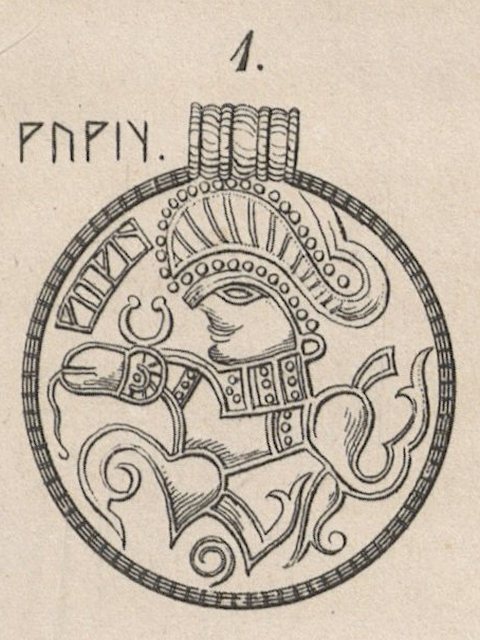
Image provided by Wolański, Tadeusz (1785-1865), Gniezno 1846., CC BY-SA 4.0 <https://creativecommons.org/licenses/by-sa/4.0>, via Wikimedia Commons.