Andrew Withers FRSA
History, as it has been taught for centuries, states that in 1066 at the Battle of Senlac Hill, Guillaume the Bastard of Normandy became King of England.
Anglo-Saxon England did not die on October 14th, 1066; far from it, the struggle against yet another large-scale Nordic incursion on the scale of ‘The Great Heathen Army’ two centuries earlier in 865 AD continued. This great Heathen army consisted of possibly only one to three thousand men, who were battle-hardened and not looking for a ‘Danegeld’ payoff; the intention was to take England, which would be more profitable in terms of gold, silver, and slaves. The Norse sagas tell of a more poetic reason. It was led by the sons of the semi-legendary Ragnar Lothbrok.
The Great Heathen Army stayed in England for eight years. The Kingdom of Wessex, under both Aethelred and Alfred, put up a staunch defence, finally defeating the Heathen Army at the Battle of Edington sometime in May 878. England was divided between Saxon England and what became known as Danelaw.
Danelaw started to collapse with the death of Guthrum; both Edward the Elder and Aetheflaed, Lady of the Mercians, harried the Danes into submission. Aethelstan, the grandson of Aelfred the Great, effectively unified England in 937 at the Battle of Brunanburh on the Wirral, against a combined force of Dublin Vikings, Scots under Constantine and Owain of Strathclyde. This battle, though forgotten, is cited as the foundation of the English Kingdom. The Historian Aethelweard wrote in 975, ‘the fields of Britain were consolidated into one, there was peace everywhere, and abundance of all things.’
Anglo-Saxon England was well run, remarkably urbanised and rich, which made it such a target for raiders. Although primarily rural, it had towns whose wealth came from trade. London, York, Winchester, Ipswich, and Thetford
The St Brice’s Day massacre of Vikings was ordered by Aethelred the Unraed in 1002, following yet another rebellion. More and more burial pits have been uncovered, and at one such site, currently, the number is about thirty-seven executed males.
The first ‘Norman Conquest ‘ of Danes bent on revenge forced Aethelred to flee to Normandy, in repeated raids in response to the St Brice’s Massacre, in 1013 Swein Forkbeard of Denmark, who had already conquered vast tracts England, was acclaimed King, in 1014 Forkbeard died and Aethelred returned and drove out his son Canute, Aethelred died in 1016, and a dynastic civil war broke out between his son Edmund Ironside and Canute. Edmund Ironside also died in 1016. Canute assumed the throne of England in 1016, reigning until his death in 1035. England became part of his Northern Empire, including Norway and Denmark
During the sixty years before Senlac Hill, England was a settled and rich country, but still a target for invaders. The three battles, Fulford, Stamford Bridge, and Senlac Hill, in 1066 were in effect a continuation of the conflict that had been going on for two hundred years, so to make the statement that Guillaume the Bastard simply became King in 1066 is not in line with reality. The Anglo-Saxon Kingdom of the Englisc had repeatedly come back from disaster since the time of Aelfred, having to seek refuge on the Isle of Aethelney.
The Ascendancy of the House of Godwin to October 1066
The founder of the House of Godwin, Godwin, was awarded the Earldom of Wessex by Canute. This family rose from obscurity. Wessex and the House of Cerdic were the fiefdom of the line of Aelfred. The rise of this family reflected their allegiance to the usurper Canute.
When Canute died, the throne was disputed between his sons Harold Harefoot and Harthacnut; these two half-brothers; the former’s mother was Aelfgifu of Northampton, the latter’s mother was Emma of Normandy. It was agreed that Harold would act as Regent while Harthacnut was fighting in Denmark.
In 1036, the son of Emma and Aethelred, Alfred the Aetheling (the Prince), attempted an invasion of England. He was intercepted by Godwin, who handed him over to Harold Harefoot. He was blinded.
In 1037, with Godwin’s support, Harold ascended the throne as Harold I. In 1040, Harold died, and again Harthacnut, with Godwin’s support, ascended the throne. Harthacnut only ruled until 1042, the year of his death.
Godwin engineered the accession of Edward, the last remaining son of Aethelred, who became Edward the Confessor. Edward had spent the previous thirty years living in Normandy.
The native House of Wessex had been restored, in 1042-66.
Earl Godwin arranged for Edward to marry his daughter, Eadgytha (Edith). Godwin died in 1053. Earl Godwin sired by his wife Gytha Thorkelsdottir, Harold Godwinson, Tostig Godwinson, Sweyn Godwinson, Edith of Wessex, Wulfnoth, Leofwine, Gyrth, Alfgar, Edgiva, and Aelfgifu.
This was an Anglo-Danish family, not one of the Saxon Wessex bloodline.
Edward the Confessor’s mother was Emma of Normandy; he spoke Norman French and retained his Norman advisors. It is now believed that due to the hatred of his father-in-law and his involvement in the murder of his brother Alfred in 1036, he never fathered any children by Edith.
With Edward the Confessor on the throne being childless, it was inevitable that conflict would happen the moment that Edward the Confessor died. Edward’s reliance on the Godwinson’s military power meant that he inevitably had made conflicting promises to potential heirs.
The End of Days
The chronology of the events that led to the Battle of Senlac Hill (Hastings) is well known. While anticipating the threatened invasion by William of Normandy in the south, word reached Harold of a landing near York of a ‘host’ led by Harald Hardrada and his own brother Tostig. This should be seen as a fairly common event in dynastic conflict when a new King sought to consolidate his power. Much the same happened when Henry VII seized the throne at Bosworth centuries later.
The support of Tostig, brother of Harald Godwinson, for Harald Hardrada’s claim to the throne of England and the support of Orre Eystein, a Norwegian Noble who was betrothed to Harald Hardrada’s daughter, were arguably the last contest between the Vikings and the Anglo-Danish family of the Godwinsons, before the Battle of Senlac Hill.
The Earls Morcar and Edwin had confronted Hardrada at Fulford south of York and were defeated, leaving York to surrender to Hardrada on the 24th September 1066.
Harold carried out a remarkable military feat of dashing north with his Huscarls, and as many Thegns as he could muster. He covered the one hundred and eighty-six miles at lightning speed in four days, catching Tostig and Hardrada by surprise at Stamford Bridge in Yorkshire. Utterly destroying the host, killing both Hardrada and Tostig. Hardrada and Tostig had split their force, leaving Orre to guard their ships and York. Roughly one-third of the host had been depleted.
Recently, an alternative proposition has been put forward by Professor Tom Licence of the UEA: that Harold did not force-march to Yorkshire and back, thus exhausting his army to certain defeat.
A new examination of early chronicles believes that Harold had at his disposal a substantial fleet and sailed to the Humber from London; the local fyrd was ‘called out,’ and these ships reinforced the Fyrd with Harold and his elite Huscarls. The Latin was mistranslated, thereby speeding up his manoeuvre without reference to moving by land. The Chronicles state that the fleet returned ‘home’; this was mistranslated as being disbanded. The existence of this fleet has largely been disregarded, yet Harold’s mother fled to Ireland, and Harold’s sons to Scandinavia. In the 1090’s a large English fleet carried English warriors into exile to fight for the Byzantine Emperor. At the time of Senlac Hill this fleet had not been committed
The Battles of Stamford Bridge and Fulford
The support of Tostig, brother of Harald Godwinson, for Harald Hardrada’s claim to the throne of England and the support of Orre Eystein, a Norwegian Noble who was betrothed to Harald Hardrada’s daughter, were possibly the last conflicts between the Vikings and the Anglo-Danish family of the Godwinsons, before the Battle of Senlac Hill.
Harold then turned south with his Huscarls to confront William and his assembled Flemish, Breton and Norman mercenaries. William had secured a Papal banner from Pope Alexander II, so he felt he had the personal blessing of his God, and it was designed to undermine the English resolve to stop another invader.
The battle was lost at Senlac Hill when Harold was hacked down by four ‘knights,’ including Eustace of Boulogne, Hugh of Ponthieu and Giffard acting as a ‘hit squad.’
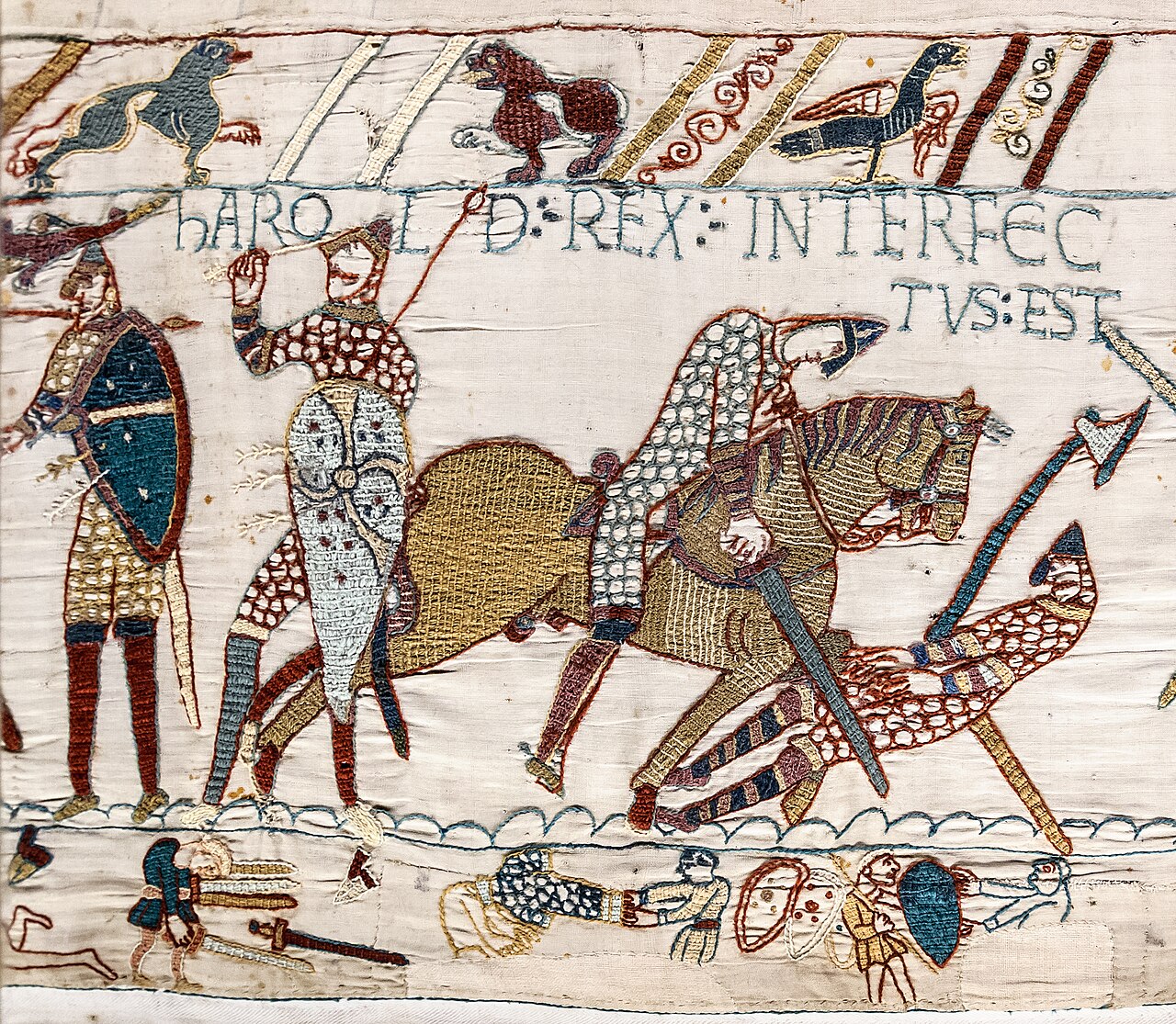
Four of Guillaume’s mercenaries, Eustace, Hugh, and Gilfard, are named to directly attack Harold and his Huscarls as a pre-emptive strike. The panel on the Bayeux tapestry, below the Latin text “King Harold is Killed,” is of a horseman cutting into a man’s leg. The arrow in the eye narrative is probably due to a poor repair of a Huscarl wielding a lance or a spear.
Three women are depicted in the embroidery: one is named Aelgyva, fleeing from a burning building, and another is Harold Godwinson’s sister, Edith, widow of Edward the Confessor. Aelgyva is significant enough to be included. She is potentially one of Harold’s younger sisters.
Wiping out the family of the legitimate, or in this case semi-legitimate, rulers in a military coup has been common practice from the Tudors to the Romanovs
Harold Interfectus Est (Harold is Killed) is not related to the infamous ‘shot in the eye’, but to a man cut down with a sword. Guillaume is known to have offered land and riches to anybody who dispatched Harold early enough to conserve his relatively small invasion force.
No arrow is mentioned in the Carmen de Hastingae Proelio, attributed to Guy of Amiens and written sometime before 1068. Nor is it referred to by William of Jumièges, who wrote early in 1070 and says only that “Harold himself was slain, pierced with mortal wounds.” Rather, the king is attacked by William, Eustace of Boulogne, Hugh of Ponthieu, and Giffard; “these four bore arms for the destruction of the king.” All were richly rewarded with lands in both Normandy and the Marches of Wales and England. Land that is still held by their descendants to this day.
“The first, cleaving his breast through the shield with his point, drenched the earth with a gushing torrent of blood; the second smote off his head below the protection of the helmet and the third pierced the inwards of his belly with his lance; the forth hewed off his thigh and bore away the severed limb: the ground held the body thus destroyed.“
Clearly, Harold Godwinsson was dismembered on the field, only identified by one of Harold’s wives, Edith Swan Neck, recognising intimate parts of his body. She was the mother of Harold’s children, Godwin, Edmund, Magnus, Gytha, Gunnhild, and Ulf.
There is much debate as to whether his remains were interred at his childhood home at Bosham or at Waltham Abbey. The balance of contemporary evidence is that he was interred at Waltham Abbey, but his grave is now lost.
Much time and propaganda have been spent on the Battle of Senlac Hill (Hastings), including the Bayeux Tapestry. This appears to have been created on the orders of Bishop Odo; however, Odo was Guillaume’s half-brother. Most scholars now agree that the embroidery (not a tapestry) was created in Canterbury, England, by English hands to adorn Odo’s new Cathedral in Bayeux in 1077, eleven years after Senlac Hill.
Not surprisingly, Odo elevated the importance of his role in the defeat of Harold Godwinson, including a scene in which he is depicted as a Christ-like figure. Political spin has a thousand-year history.
Three women are depicted in the embroidery: one is named Aelgyva, fleeing from a burning building, and another is Harold Godwinson’s sister, Edith, widow of Edward the Confessor. Aelgyva is significant enough to be included. Potentially one of Harold’s younger sisters.
Wiping out the family of the legitimate or, in this case, semi-legitimate rulers in a military coup has been a common practice through to the Tudors and Romanovs.
Was Senlac Hill the End of England Ruled by the Englisc?
The history books written by the descendants of the Norman victors say yes. This is far from the truth. There was an almost 20-year period of English Resistance until 1085.
Motte and Bailey castles built by the Normans were at best ‘strong points’, much like American ‘fire bases’ in Vietnam. The Normans only really controlled the land inside the Motte and Bailey; the land still belonged to the Englisc.
Of Harold’s sons, Ulf threw his lot in with Robert Curthose, the eldest son of William, who, as Duke of Normandy, knighted him. Robert lived to the age of eighty-three and was a pretender to the Throne of England. Ulf disappeared from history following Robert’s repeated failure to take the throne. Two of Harold’s other sons, Godwin and Edmund, invaded England in 1068 and 1069 with the aid of Diarmait mac Máel na mBó (High King of Ireland) but were defeated at the Battle of Northam in Devon in 1069.
Harold’s immediate descendants were actively trying to regain Harold’s legacy in 1087.
In 1067, Eadric the Wild allied with the Welsh Princes Bleddyn and Rhiwallon and fought against the Norman Marcher Lords who had been awarded lands by William, ransacking Hereford before disappearing back into Wales.
The Witan was convened upon Harold’s death, and powerful English magnates elected Edgar the Aetheling to the throne. Edgar was the last of the Royal House of Cerdic of Wessex. He was born in 1052 in Hungary, the son of Edward the Exile. Edward was the son of King Edmund Ironside and Ealdgyth. He initially submitted to William but took part in the Rebellion of Morcar and Edwin in 1068. Trying to return to Hungary, he ended up at the Court of Malcolm III of Scotland, who granted him and his family asylum.
In 1069, he returned south to join the Rebellion in Northumbria, which failed, and the survivors, including Edgar, fled back to Scotland. The rebellion had been encouraged by the presence of Edgar Aetheling. The Anglo- Saxon Northumbrians, in alliance with Anglo-Scandinavians and Danes, raised a rebellion. William resorted to the old tactic of ‘Danegeld paying the Danes to go home.
This failed Rebellion led to the ‘Harrying of the North’ (1069/70). This was a brutal scorched earth policy; there was an orgy of looting, burning and slaughter. Records such as the Domesday Book in 1086 suggest that as much as 75% of the population may have died or fled during the ensuing famine. Some modern scholars write of the Harrying as a near genocide.
Resistance in the West 1067
Exeter was a stronghold of Anglo-Saxon resistance to William; the city was besieged by William. Exeter was commanded by the remarkable Gytha Thorkelsdottir, Wife of Earl Godwin. It is commonly assumed that Edith, Harold’s wife and his children also sought refuge in Exeter. William moved quickly against Exeter, the stronghold of the Godwinsons. He celebrated Christmas in London, was crowned, heavily guarded by his nervous troops, and started his campaign in the months of Winter. He also called out the Fyrd to support him as a test of loyalty to his new subjects,
En route, he pillaged and burnt the towns supporting the Godwinsons – Bridport, Shaftesbury, and Dorchester. The damage was still recorded in the Domesday Book eighteen years later.
Exeter was not universally supportive of Gytha. On William’s arrival before the gates of Exeter, one party sent a delegation and submitted to William, offering hostages. When Gytha’s party closed the gates of Exeter, William blinded one of the hostages. The divided City survived an 18-day siege. Gytha fled the city by boat down the river Exe with some of her supporters. William gave generous terms on Exeter’s surrender, which says more about the weakness of William’s hold on power.
Gytha left England, together with the wives, widows and families of prominent Anglo-Saxons. It is probable that she sought refuge with her relatives in Scandinavia. She died in 1069. Her youngest and only surviving son, Wulfnoth, lived all his life in captivity in Normandy until the death of William in 1087.
Hereward the Wake, Revolt in the East
In 1070 to 1071, the Danish King Sweyn, according to the Anglo-Saxon Chronicle, invaded East Anglia in support of Hereward, a hitherto unknown thegn. William resorted to the old policy of Danegeld to buy the Danes off. Hereward, however, became the symbol of English resistance against William from his base on the Isle of Ely, fighting a guerrilla campaign. While allied with Sweyn, he stormed Peterborough Abbey, and the treasures seized were taken to Denmark. Eventually, Hereward submitted to William, dying in 1072 at the young age of thirty-six. The rebellion in the East petered out on his death.
Revolt of the Earls 1075
William’s tenuous hold on England and ongoing resistance by the Anglo-Saxons were also compromised by his own supporters, the Anglo-Normans.
Having returned to Normandy in 1073, leaving England in the charge of his half-brother Odo and William FitzOsbern. Both had fought at Senlac Hill and were his most trusted allies,
The cause of the Anglo-Norman Revolt against William was his refusal to sanction the marriage of William Fitz Obern’s daughter, Emma, to Ralph De Guader, Earl of East Anglia. They defied William and married anyway.
While William stayed in Normandy, Roger De Breteuil and Waltheof, Earl of Northumberland, started a revolt. Waltheof lost heart almost immediately, confessing his part in the conspiracy to William.
Roger, who planned to bring his forces East to join Ralph, was held in check on the Severn by the Saxon Bishop Wulfstan and the Worcestershire Fyrd. Ralph was stopped in his tracks near Cambridge by Odo of Bayeux and the Norman loyalist Geoffrey de Montbray, the latter of whom commanded that any rebels caught would have their right foot cut off.
Ralph and Emma retreated to Norwich. Ralph left for Denmark to seek help, and Emma stayed to defend Norwich.
Two hundred Danish ships returned with Ralph but proved ineffective. Emma held out in Norwich and finally obtained terms that gave her forty days to leave England. She retired to her estate in Brittany, later joined by her husband Ralph.
Roger De Breteuil was imprisoned, then beheaded after William’s death in 1087. The weak-willed Waltheof was beheaded in 1076 at Winchester; he was buried at Crowland Abbey. To placate the Bretons, Brian of Brittany, who had been deposed following the Revolt, ceded his lands to Robert, Count of Mortain (another of William’s half-brothers). Ralph’s lands in East Anglia were ceded to the Breton Alan Rufus.
By 1075, William’s hold over England was largely secure, despite continual threats of invasion from Denmark. The Domesday Book was commissioned in 1086. William, however, died on campaign in 1087 in Northern France, his stomach impaled on the pommel of his saddle. He was buried in Caen.
England and Normandy were never integrated. Robert, his eldest son, inherited Normandy, and William Rufus inherited England.
William Rufus was killed in the New Forest by possibly adherents of his brother, who became Henry I. The agreement to split Normandy and England preserved England as a separate entity created by Aethelstan.
The Last King of the English
Edgar Aethling, last of the House of Wessex, outlived both William and William Rufus, living until 1125, dying at the age of seventy-three, although some accounts have him living to one hundred. He had certainly seen the death of Henry’s heir in the wreck of the White Ship in 1120.
He appears to have abandoned his estates in England and moved to Norman Apulia in Italy.
In 1098, he is recorded as commanding Anglo-Saxon members of the Varangian Guard to bring supplies of siege equipment for the Byzantine Emperor Alexius I.
The contemporary Orderic Vitalis records vast numbers of deposed Anglo-Saxon nobles and warriors simply left England to serve in the Varangian Guard.
And so the English groaned aloud for their lost liberty and plotted ceaselessly to find some way of shaking off a yoke that was so intolerable and unaccustomed. Some sent to Sveinn, king of Denmark, and urged him to lay claim to the kingdom of England … Others went into voluntary exile so that they might either find in banishment freedom from the power of the Normans or secure foreign help and come back and fight a war of vengeance. Some of them who were still in the flower of their youth travelled into remote lands and bravely offered their arms to Alexius, emperor of Constantinople, a man of great wisdom and nobility. Robert Guiscard, Duke of Apulia, had taken up arms against him in support of Michael whom the Greeks—resenting the power of the Senate—had driven from the imperial throne. Consequently, the English exiles were warmly welcomed by the Greeks and were sent into battle against the Norman forces, which were too powerful for the Greeks alone. The Emperor Alexius laid the foundations of a town called Civitot for the English, some distance from Byzantium; but later, when the Norman threat became too great, he brought them back to the imperial city and set them to guard his chief palace and royal treasures. This is the reason for the exodus of the English Saxons to Ionia; the emigrants and their heirs faithfully served the holy empire, and are still honoured among the Greeks by the Emperor, nobility, and people alike.
By the time of Emperor Alexios Komenenos (1057-1118), the influx of English speakers was so great that English was the functional language of the Guard as late as the fourteenth century, and there is also evidence that the Byzantine emperor actively recruited from England. Lead seals belonging to the chief financial ministry of Byzantium have been found along the banks of the Thames, suggesting that a financial incentive was being offered to English warriors.
Interestingly, it is thought that the first military engagement for many of these warriors on behalf of the empire was against the Norman warlord Robert Guiscard, who was invading the Byzantine Balkans from his base in Italy. One can only speculate how much English antipathy towards the Normans might have helped to motivate the warriors in this campaign.
At the Battle of Dyrrhachium (now Durres) in 1082, the Byzantine Emperor and the Normans locked horns. Some one thousand Varangian Guard, thought to be English, were killed when they were cut off from the main army.
New England
Both the Icelandic saga called the Edwardsaga and a chronicle written by an English monk in the 13th century, the Chronicon Universale Anonymi Laudunensis, describe a fleet of several hundred English ships sailing through the Mediterranean to the aid of Constantinople, which was under siege.
The Edwardsaga tells us that Emperor Alexios was so grateful for their intervention that he granted these warriors a piece of land to settle. This land was supposedly six days and nights sailing to the north of Constantinople, which would put it in modern Crimea. Here, the warriors occupied the land and founded cities that they called London and York in a country called ‘Nova Anglia’ (New England).
There are tantalising scraps of evidence to support this story. At around this time, the Byzantine Empire appears to have re-established control over the Crimean Peninsula.
Coastal charts made by European sailors in the 14th to 16th centuries show a settlement called Londina on the Black Sea coast. Franciscan friars who had been sent by the pope on a mission to the Mongols in the 1240s say that the people of this area were Christians and formidable warriors, and were called ‘Saxi’, which many scholars interpret as meaning ‘Saxon.’
Sadly, Archaeological evidence to support the hypothesis of a colony proposed in the 1970s by Jonathan Shepard, an expert and lecturer in Byzantine and Russian History at New College, Oxford, is currently lacking.
I find the possibility that a New England existed compelling, as does the idea that this colony would have followed the Hungarian Byzantine Greek Catholic Liturgy, thereby demonstrating a further link between the House of Cerdic of Wessex and Hungary.
William the Conqueror never subdued England; he and his descendants simply terrorised the English who resisted at every step. By the time of Geoffrey Chaucer, who died in 1400, English had become the dominant language, supplanting Norman French. His contemporary, Thomas Hoccleve, hailed him as “the firste fyndere of our fair langage.”
Eighty-five years later, William’s direct descendant, Richard III, died in the mud of Bosworth Field.
Sic Semper Tyrannis
Andrew Withers FRSA
An English Exile in Normandie