
An Experiment in Comparative Reconstruction
Vladimir V. Wiedemann
-
Introduction: The Problem of Sources and the Methodological Framework
The study of Sadduceeism confronts a fundamental difficulty of sources: the Sadducees left no texts of their own. Everything we know about their doctrine has reached us through traditions that were hostile, or at least external, to them—the Pharisaic-rabbinic tradition and the Judeo-Hellenistic tradition of Josephus. As Josephus states, the Sadducees held that “the soul perishes with the body,” thereby denying not only resurrection but also the immortality of the soul, as well as “punishments in the underworld and rewards.” According to the Acts of the Apostles, the Sadducees said that “there is no resurrection, nor angel, nor spirit” (Acts 23:8).
Yet already the early rabbinic tradition connects the origin of Sadduceeism with a specific event: the misunderstanding of the words of the sage Antigonus of Sokho by his disciples Zadok and Boethus. In Pirkei Avot (1:3) we find the only preserved saying of Antigonus: “Do not be like servants who serve their master for the sake of receiving a reward, but be like servants who serve their master not for the sake of receiving a reward.” According to the Talmudic tradition, Zadok and Boethus “did not comprehend this teaching” and began to preach that “there is no future life at all; there are no rewards or punishments after death.”
Mīmāṃsā, by contrast, is one of the most documented schools of Indian philosophy. Its foundational text is the Mīmāṃsā Sūtra of Jaimini (c. 200 BCE – 200 CE), its most important commentary is the Śābarabhāṣya of Śabara Svāmin (c. 3rd–6th centuries CE), and its two main sub-schools are associated with the names of Kumārila Bhaṭṭa and Prabhākara (both 7th century CE). The central theme of Mīmāṃsā is Vedic sacrifice and the correct interpretation of Vedic texts. The first sutra of the Mīmāṃsā Sūtra defines the subject of the school as “the investigation of dharma.”
It is precisely this ambiguity—between the external denial of the afterlife and a possible esoteric core in the case of the Sadducees, and between ritualistic formalism and potential inner transformation in the case of the Mīmāṃsakas—that creates the space for comparative reconstruction. The methodological framework of this study assumes that both traditions represented not merely a “dry rationalism” or “ritualism,” but systems in which the external teaching of disinterested service and the denial of reward served as a shell for a radical immanentist mysticism. The central hypothesis may be formulated as follows: for both secret Sadduceeism and secret Mīmāṃsā, ultimate reality has no image in the world other than the perfect man, who is not “like” God or the cosmic order—he is their manifestation; to know them means to become what they are.
-
Sadduceeism: From the Teaching of Antigonus to Secret Immanentism
2.1. The Teaching of Antigonus of Sokho and Its Radical Interpretation
Antigonus of Sokho (3rd century BCE) occupies a unique place in the chain of transmission of oral tradition. According to Pirkei Avot, he was a disciple of Simon the Just and transmitted tradition to Jose ben Joezer and Jose ben Johanan. His only preserved saying became the starting point for an entire religious movement. The key term here is peras (פרס), which in the commentary tradition (Bartenura, Rashi) is explained as an “undeserved gift,” a “handout”—that which a master gives to a servant beyond any obligation. The meaning of Antigonus’s teaching, therefore, consists not in denying reward as such, but in demanding disinterested service, unmotivated by self-interested calculation.
According to Avot de-Rabbi Natan (A, 5 and B, 10), Antigonus had two disciples—Zadok and Boethus—who “did not learn properly” and drew a radical conclusion from their teacher’s words: if one must serve God not for the sake of reward, then, consequently, reward does not exist at all—neither the afterlife nor the resurrection of the dead. From this conclusion they derived an entire system of views and founded two sects: the Sadducees (from the name Zadok) and the Boethusians (from the name Boethus).
However, the Talmudic tradition, hostile to the Sadducees, presents their teaching as a distortion of the true tradition. From the Pharisaic point of view, Zadok and Boethus were “disciples who did not learn properly” and misunderstood their teacher’s words. It is precisely this polemical framework that creates the possibility of an alternative reading: what if the “misunderstanding” was in fact the deliberate concealment of a secret doctrine accessible only to the initiated?
2.2. Theological Foundations: The Pentateuch, Free Will, and Disinterested Service
The theological system of the Sadducees was built on strict adherence solely to the Pentateuch of Moses. The Sadducees rejected the oral Torah of the Pharisees and did not grant the Prophetic books the same authority as the Law of Moses. Since the first five books of the Bible contain no explicit and unambiguous indications of resurrection or postmortem retribution, the Sadducees rejected these doctrines as having no basis in the Law. Josephus confirms that the Sadducees accepted “only the laws written by Moses.”
The second key element of their theology was the doctrine of free will. The Sadducees completely rejected predestination and fate, holding that “all things are in our power.” God granted man free will so that he might himself “arrange his own well-being.” Reward and punishment are not a “deferred” postmortem compensation, but the natural consequence of actions already in this life.
The third element is the ideal of disinterested service. The logic of the Sadducees was as follows: if one must serve God disinterestedly, not for the sake of reward or fear of punishment, then the very idea of postmortem retribution destroys this pure love. For if there is a reward, service becomes mercenary. Hence they came to deny resurrection and the afterlife.
2.3. The Secret Core: The Perfect Man as the Embodiment of God
If the external teaching of the Sadducees was strict rationalism and ethical rigourism, the secret core reconstructed in this work is a radical immanentism centred on the figure of the perfect man as the embodiment of God.
The Temple as the body of the perfect man. The Sadducees controlled the Jerusalem Temple and were a priestly aristocracy. Externally, the Temple was the centre of sacrifices and ritual purity. In the secret reading, however, the Temple was understood as the image of the body of the perfect man. The prophet Ezekiel provides a key justification for the exclusive role of the “sons of Zadok” (בני צדוק), to whom God entrusts service at the altar in the future Temple: “But the priests, the Levites, the sons of Zadok, who kept charge of My sanctuary when the children of Israel went astray from Me, they shall come near to Me to minister to Me” (Ezek. 44:15). For the historical Sadducee priests, this was a prophetic justification of their exclusive status. In the secret key, however, this revelation may be read as an indication that the perfect man—the one who, like Zadok, “kept charge of the sanctuary”—is the true high priest, the embodiment of God.
The fulfilment of Torah as an ontological process. For Sadducee esotericism, the fulfilment of Torah is not a juridical observance of a code, nor a way of earning a reward, but an ontological process: bringing oneself into conformity with the divine order until one becomes a living expression of Torah. Torah is understood not as an external law but as the structure of being, given by God through Moses. To fulfil it means not merely to “do” but to become.
Messianic expectations: high priest, not king. The secret ideology of the Sadducees radically reinterpreted messianic prophecies as well. If the Pharisees expected the Messiah from the line of David, the Sadducees, rejecting the authority of the Prophets in favour of the Pentateuch, derived the Messiah from the line of Aaron and Phinehas. In their secret teaching this meant: the Messiah is not a future king but the present perfect high priest, in whom God has already manifested Himself.
-
Mīmāṃsā: From Ritualistic Formalism to the Secret Doctrine of Svar-nara
3.1. The Exoteric Teaching: Ritual, Apūrva, and Svarga
Mīmāṃsā (Pūrva Mīmāṃsā) is a school whose principal aim is the defence and justification of Vedic ritualism. For Mīmāṃsā, the idea of an afterlife is a necessary presupposition for the meaningfulness of ritual. If sacrifice does not bear fruit after death, then Vedic injunctions lose all meaning. Therefore Mīmāṃsā consistently affirms the reality of the soul (ātman), postmortem retribution, and the cycle of rebirths.
The central concept of Mīmāṃsā is apūrva. According to Prabhākara, apūrva is “an invisible force linking the ritual action to its result.” As Patrick Cummins notes, Śālikanātha “positions apūrva—the capacity of sacrifice to produce results across time—at the summit of the linguistic hierarchy in his theory of the archetypal Vedic injunction: svargakāmo yajeta (‘The man desiring heaven should sacrifice’).” Apūrva is “a mysterious wondrous power, not coming to man from outside, but ‘growing’ from the depths of his being.”
Svarga (“heaven”) in Mīmāṃsā is not simply a “place” but a form of happiness that is the result of a correctly performed ritual. According to Mīmāṃsā, “svarga is not something that brings pleasure; it is pleasure itself, identified with heaven.” The goal of ritual is the attainment of svarga after death, and it is this that makes the Vedic injunctions meaningful.
3.2. The Secret Core: Svar-nara, the Heavenly Man
If the external teaching of Mīmāṃsā was strict ritualism oriented towards the attainment of svarga, the secret core reconstructed in this work is a radical reinterpretation of ritual as a path of inner transformation. The central figure becomes Svar-nara—the “Heavenly Man.”
Ritual as inner sacrifice. For the uninitiated, sacrifice is an action with fire, soma, and offerings. For the initiated, it is an inner act. Agnihotra becomes the maintenance of the inner fire of consciousness. Soma is not a drink from a plant but the extract of immortality, awakened in the depths. Offerings are the surrender of feelings and desires. Priests are the powers of the soul. Mantras are breath, uttered not by the lips but by one’s very being.
Svar-nara performs the eternal sacrifice: he gives himself into the world and returns the world into himself. The person who performs the ritual with understanding does not “earn” heaven—he becomes this Man. Apūrva, then, turns out to be not a mechanical potency but the trace (vāsanā) of self-recognition: when a person acts in accordance with Svar-nara, the memory of what he has always been is awakened in him.
Svarga and dharma: transformation here and now. Externally, Mīmāṃsā promises svarga after death. In the secret teaching, svarga is not a heavenly world but a state of identity with Svar-nara here and now. Not a reward for ritual, but the very essence of ritual, understood as an ontological act. Dharma ceases to be a set of rules. It becomes the cosmic rhythm that Svar-nara holds by his breath. To fulfil dharma means to act disinterestedly, without calculation of fruits, because all calculation is a fall from the rhythm into self-interest.
-
Comparative Analysis: Constructive Similarity of the Secret Teachings
Historically, the Sadducees and the Mīmāṃsakas belong to entirely different worlds: the Jewish priestly aristocracy of the Second Temple and the Indian school of Vedic ritualism. There is neither a genetic connection nor direct influence between them. However, if we accept the hypothesis of a secret, esoteric core in both traditions, a profound constructive similarity emerges between them—not in the content of doctrines, but in the very architecture of the religious system.
4.1. Two-Level Structure: Exoteric Literalism and Esoteric Immanentism
Both the Sadducees and the Mīmāṃsakas construct their system as two-layered. For the people—strict literalism, the promise of earthly good or heavenly reward, precise fulfilment of injunctions. For the initiated—the understanding that the meaning of ritual is not in reward but in ontological transformation. The masses need form, for they cannot contain the formless. The elite see in that same form symbol and path.
In the case of the Sadducees this is expressed in the opposition between the Written Torah and the Oral Torah of the Pharisees: externally—only the letter of the Pentateuch; internally—the letter as the living tissue of the divine order. In the case of the Mīmāṃsakas—in the opposition between ritualistic formalism and the secret doctrine of Svar-nara: externally—vidhi and apūrva; internally—ritual as the path of becoming the Heavenly Man.
4.2. Scripture as an Ontological Code, Not Merely Law
For the Sadducee, the Pentateuch is not a collection of rules but the direct manifestation of God’s will, the structure of being. For the Mīmāṃsaka, the Vedas are a text created by no one, an eternal impersonal law that sustains the cosmos. In both cases, sacred scripture is understood not as an object of interpretation but as an instruction for being. It must not be “understood” but fulfilled to the end, until man becomes its living expression.
According to Mīmāṃsā, the Vedas are apauruṣeya—“authorless,” eternal, and infallible. The Mīmāṃsakas developed an entire system of proofs for the “authorless” origin of the Vedas, but in essence their authority was axiomatic, self-validating (svataḥ-pramāṇa). The truth of the text was not derived from anything external but was grasped directly through the text itself.
4.3. The Priority of Action over Faith
For both traditions, salvation or the correct life was attained not through “faith” in dogmas but through the precise performance of prescribed actions. The Sadducee fulfilled the letter of the law in order to live in accordance with the divine order; the Mīmāṃsaka performed ritual in order to sustain dharma. In both cases, orthopraxy (right action) prevailed over orthodoxy (right opinion).
4.4. Disinterestedness and the Rejection of a Mercenary Eschatology
The Sadducees, according to tradition, denied postmortem retribution precisely in order to serve God disinterestedly. The secret Mīmāṃsakas reinterpret svarga as a state, not a reward. Both systems affirm: action is performed for the sake of action itself, dharma for the sake of dharma, Torah for the sake of Torah. This is the principle “truth beats fitness”: truth is more important than adaptation, fidelity more important than advantage.
4.5. The Perfect Man as Goal
Both traditions refuse to await a future redeemer or a postmortem reward. The goal is here and now. For the Sadducee it is the “perfect man,” the “living Torah,” the “walking Temple.” For the Mīmāṃsaka it is Svar-nara, the Heavenly Man, the true subject of every action. In both cases, what is at stake is not the “salvation of the soul” but becoming what man is in his depths. The Messiah of the Sadducees is not a future king from the line of David but the present perfect high priest. The svarga of the Mīmāṃsakas is not a heavenly world after death but a state of identity with Svar-nara in the act of ritual.
4.6. Eschatology of the Present
Both secret doctrines cancel linear eschatology. There is no future Judgement, no coming Messiah, no heaven after death. There is an eternal present, in which the perfect man fulfils Torah or Dharma. The Sadducee on Yom Kippur and the Mīmāṃsaka in the eternal sacrifice live in one time—the time of encounter with God or the cosmic order.
-
Divergences: Theism and the Impersonal Order
Despite the structural similarity in “mystical mechanics,” a gulf lies between the two systems in their metaphysics. The Sadducee path is theistic and historical: the God of Israel is a personal Creator who has revealed Himself in history. The Mīmāṃsaka path is impersonal and cosmic: the Vedas are eternal and created by no one, dharma is an impersonal law sustaining the world.
Mīmāṃsā, as scholars note, “displays no deep interest in the existence of God.” Its aim is not mystical union with a personal God but the correct performance of ritual that sustains the cosmic order. For the Sadducee, the fulfilment of Torah is an encounter with the personal God who is “here,” in the Temple, in the high priest, in the perfect man.
Furthermore, Mīmāṃsā affirms the reality and eternity of the world, its constituent material elements, and souls (ātman), subject to the law of karma. Sadduceeism, by contrast, knows neither karma nor reincarnation. Its eschatology is not a cycle of rebirths but a single life, in which man either fulfils Torah or does not.
-
Conclusion
The reconstruction of the secret doctrines of the Sadducees and the Mīmāṃsakas undertaken in this work allows us to see in these two traditions not “dry rationalists” and not “ritualists,” but radical immanentists for whom the denial of a mercenary eschatology was not scepticism but purification.
Their ideology of service was based on the ethical ideal of disinterested love, which logically led to a reinterpretation of postmortem retribution; on faith in the boundless free will and moral responsibility of man in this life; on sacral pragmatism, in which the Temple or the sacrificial altar was the centre of the divine order on earth; and on political realism directed towards the preservation of the sacred centre.
The final formula of both secret doctrines may be expressed as follows: God (or the cosmic order) has no body other than the perfect man. There is no resurrection other than awakening to this truth. There is no Temple other than the body filled with Torah or Dharma. There is no service other than the free life in God or in the rhythm of the cosmos. Whoever has attained perfection is the embodiment of God or the Heavenly Man.
Of course, the proposed reconstruction is hypothetical. It cannot be confirmed by direct sources, since the Sadducees left no texts of their own, and Mīmāṃsā has preserved no evidence of such an esoteric teaching. However, it allows us to explain a number of difficult features of both traditions: their radical literalism alongside profound philosophical reflection; their strict rigourism alongside a readiness for political compromise; their connection with the figure of the perfect man—the “son of Zadok” among the Sadducees and Svar-nara among the Mīmāṃsakas.
The constructive similarity of secret Sadduceeism and secret Mīmāṃsā consists in the fact that both systems transform a religion of reward into a religion of transformation. They use literalism not as a limitation but as a method: strict adherence to text and ritual becomes a discipline leading to the becoming of the perfect man. The external law is a veil; the inner meaning is becoming a divine or cosmic man. The difference remains in metaphysics: the Sadducee path is theistic and historical, the Mīmāṃsaka path is impersonal and cosmic. But the architecture is one: the letter, fulfilled to the end, becomes flesh; ritual, performed disinterestedly, becomes being; man, having become Torah or Dharma, is the manifestation of God or the Heavenly Man.
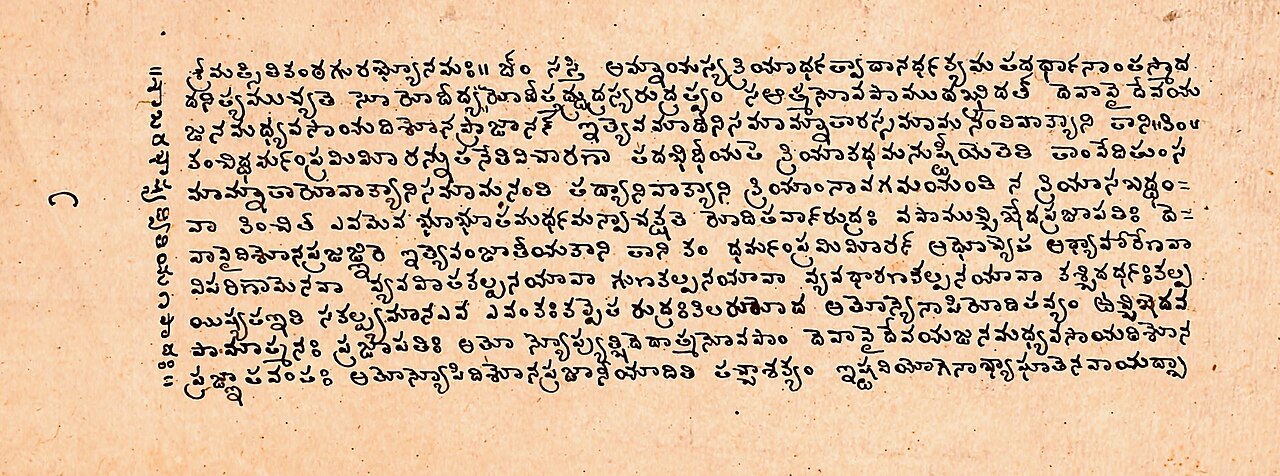
Image Attribution: https://commons.wikimedia.org/wiki/File:16th-century_Jaiminiya_Mimamsa_Sutra_Bhasya,_Sanskrit,_Telugu_script,_Andhra_Pradesh.jpg, Ms Sarah Welch
https://creativecommons.org/licenses/by-sa/4.0/ via Wikimedia Commons
References
- Pirkei Avot (Sayings of the Fathers), 1:3.
- Avot de-Rabbi Natan, A, 5; B, 10.
- Josephus. Jewish Antiquities, XIII, 10, 6.
- Josephus. The Jewish War, II, 8, 14.
- Acts of the Apostles, 23:8.
- Damascus Document (CD).
- Book of the Prophet Ezekiel, 40–48.
- Jaimini. Mīmāṃsā Sūtra.
- Śabara Svāmin. Śābarabhāṣya.
- Kumārila Bhaṭṭa. Ślokavārttika.
- Prabhākara. Bṛhatī.
- Śālikanātha. Prakaraṇapañcikā.
- Schechter, S. Documents of Jewish Sectaries. Cambridge, 1910.
- Geiger, A. Urschrift und Übersetzungen der Bibel. Breslau, 1857.
- Bartenura. Commentary on Pirkei Avot 1:3.
- Rashi. Commentary on Pirkei Avot 1:3.
- Cummins, P. T. “Commands and the Doctrine of the Apūrva in Prābhākara Mīmāṃsā.” The Journal of Hindu Studies, 2020, vol. 13, no. 3, pp. 203–261.
- Meshel, N. S., Mishra, A., Mali, H. “Talmudo-Mīmāṃsā: Towards a Science of Sacrifice.” Harvard Theological Review, 2024, vol. 117, no. 4, pp. 655–680.
- “Mīmāṃsā.” Oxford Reference.
- Critical Essays on Purva Mimamsa. Archive.org.
- Prabhakara-Vijaya. Archive.org.
- Collins, J. J. Beyond the Qumran Community: The Sectarian Movement of the Dead Sea Scrolls. Grand Rapids: Eerdmans, 2009.
- Vermes, G. The Dead Sea Scrolls in English. London: Penguin, 1995.