
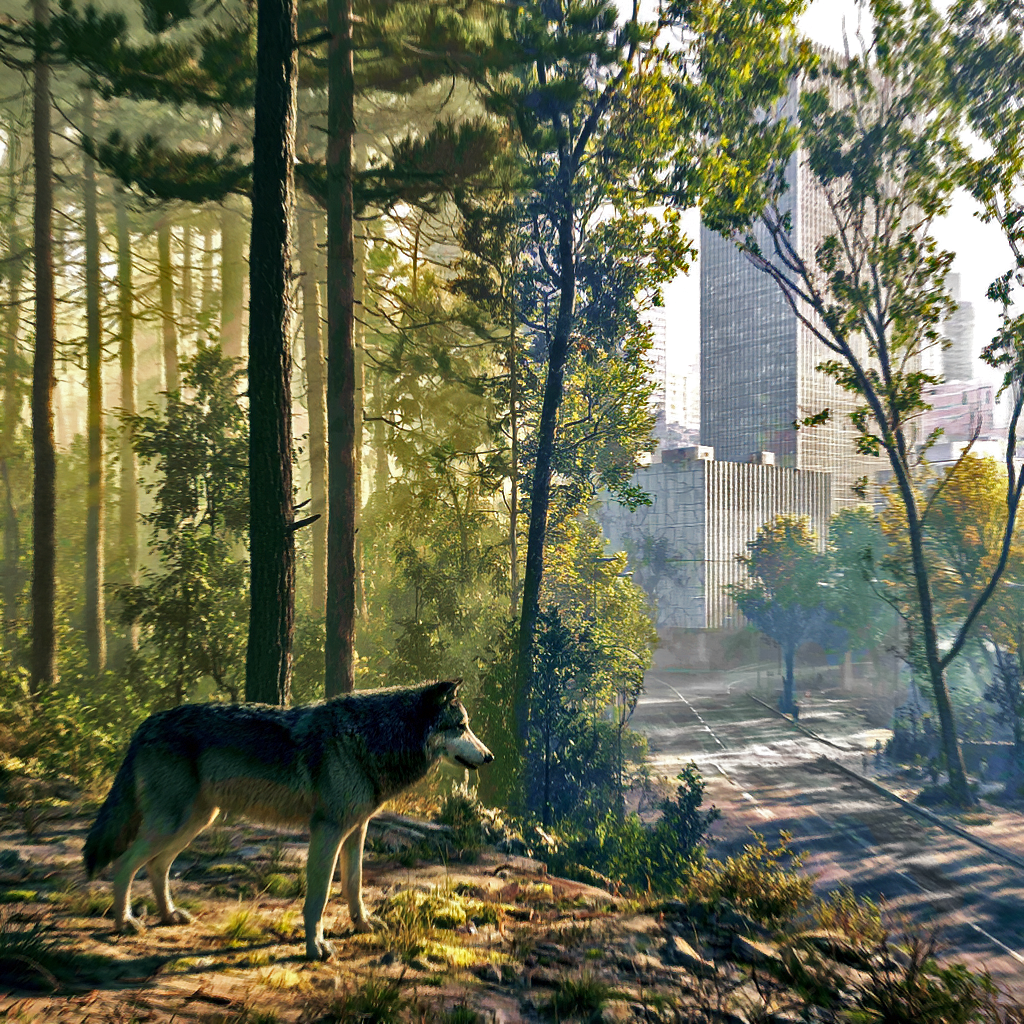
Equilibrium
The Paradoxical Duality of Germanic Heathenism and Other Misconceptions
Ian Briggs
It has been a strongly held principle that a person’s views and opinions on religion are a ‘Faith issue’. Meaning that no statement relating to religion will ever need to be supported by evidence. Since the existence of the Gods can neither be proven nor disproven (as if the existence of everything else wasn’t evidence enough), then nothing we profess to believe can be gainsaid by reason, nor anything so mundane as facts. Therefore, we are free to make whatever claims we want, regardless of how outlandish they might seem to others, just so long as they come under the banner of religion.
In the past, theologians whose motives and reasoning were not always pure and of sound mind, attempted to control which Gods people worshipped and what form religions should take, and their judgment was upheld and enforced by legions of inquisitors and sometimes even armies.
For centuries, monarchs and governments have passed laws against blasphemy, apostasy, heresy, and heathen practices, but things have changed (at least in the civilised world).
Freedom of religious belief and practice is written into law in many countries and is underpinned by international treaties and conventions; we are no longer compelled by law to conform to the tenets and practices of whatever religion the state endorses.
Yet, having been granted the license to become our own theologians, we have, in many cases, started to fall into the ways of past theologians.
In truth, religion itself is not a faith issue; only faith is an issue, for there is a clear distinction between faith and religion. The existence of the Gods is something that only we can know in our soul, and so the choice between faith and atheism is purely personal; in fact, privately, it always has been, regardless of whatever prayers and hymns we were forced to sing.
But belief in the Gods is not the same as adherence to religion.
Religion, although rooted in our faith, is a manifestation of how we practice it and, in many ways, emanates from us. It is formulated with human reason and has evolved through changing times. Its history has been spoken of and documented, and although some old tales were forgotten and some texts were lost, just enough were preserved for posterity in order for us to capture the essence of how religion has been practised over the centuries. Most religions are traceable in this way; they have a history.
If you want to know something, and know it well, then you need to study it, but if you want to understand something, you need to study its history, otherwise it’s like looking at the answer to a mathematical problem without having the formula, the working out or any idea whether or not the answer is correct.
Like the servant of Socrates who solved the Pons Asinorum with a stick in the sand, we would have all of the answers but no understanding of the question.
Everything has a history, and so history is the history of everything. Without it, we would understand little of what we think we know.
In history, provenance is everything; especially in a post-truth world where such inconvenient things as facts are deemed subjective … at least insofar as they are inconvenient. The enduring constant is human nature with all its weaknesses and failings. The historians of the past were every bit as human as we are today.
So how can we assess their works? History is the bedrock on which we stand, formed in layers over thousands of years. Lacking such a firm foundation of being, we spiral into an existentialist universe where nothing makes sense, and everything evaporates the instant it passes from our sight. We need some solid ground on which to stand.
The formula for assessing historical texts and other evidence is known to some as the ‘Primary Source Mantra.’ It is a series of questions, designed to trace an idea to its source and iron out the subjectivity as far as possible. It is as follows.
Of everything, ask,
Who said it first? Were they in a position to know?
What was their reason for saying it? Who were their intended listeners/readers?
Might they have had a reason to misrepresent the facts?
Who agreed/disagreed? How do the previous questions apply to them?
What other evidence is there? Physical, documentary, residual, etc.
How does this apply to the history of religion?
When looking at ancient evidence through a modern lens, context is needed because we need to be aware of the biases we have formed from living with current values (or at least, amongst those who preach them).
We should ask ourselves, how much of current history reads to our satisfaction?
How much of what we consider to be historical fact conforms to our personal world view or the narrative we wish to project, without the need to spin the narrative? If the answer is more than half, then we need to re-assess what we think we know, because we’re either reading the wrong books or subconsciously cooking the books ourselves.
This is the first step to how misconceptions arise and take hold, because things are not always what we want them to be. Religion is an especially tricky subject; not least because it must to some extent be what we want it to be, but although theologians no longer have the monopoly on the truth, there will never be a shortage of people who will go to extraordinary lengths to promote ‘their truth,’ and followers of the heathen religion of the Germanic peoples of England, Northern Europe, and Scandinavia (now commonly known as Odinism), are no different from any other. This is not to say that people cannot believe whatever they want to, just that they cannot claim a much-coveted basis in history without some fairly solid evidence.
Probably the greatest modern misconception relating to the Odinist Religion concerns the duality of the Germanic pantheon and what it says about the Gods, as well as about ourselves (since we are spiritually inseparable from our physical selves and the Gods from whom we came).
The Eddas and Sagas relating to Germanic mythology tell us that there are in fact two tribes/families of deities in the pantheon. The Aesir and the Vanir.
We are told that the Vanir are the elder branch of this dual pantheon, but that long ago there was a bitter conflict between the two.
Although this conflict ended with the Aesir triumphant, the Vanir were not vanquished as one would ordinarily expect, but settled into a relatively equal, if sometimes uneasy, coexistence with the victors, yet remained two separate and distinct families with distinct characters and attributes.
They dwell in separate realms – Asgard and Vanaheim – but are governed by the chief deity of the Aesir, who is most commonly known as Odin (although variants exist in various languages – Woden, Wotan, Wodenaz, etc.).
This curious dual nature, and the fact that the Aesir are noted as being the newcomers, has caused some modern practitioners of Germanic heathenism to argue that there were originally two religions which merged into one, or that an earlier religion centred around the worship of the Vanir was absorbed into an incoming faith leaving a residue similar to the traces of Germanic heathenism still to be found in the Christian practices of Northern and Western Europe (or indeed the traces of Roman heathenism in Roman Catholicism).
Applying this logic, some modern-day heathens go so far as to claim that the religion of the Aesir (which they have named Asatru) was an insurgent religion, and that the Aesir are, in fact, interlopers and usurpers. Consequently, they favour the elder, and so the original religion of the Vanir (which they have named Vanatru). There is certainly evidence for cults of individual deities, as there are in all heathen religions, but no evidence that the pantheon’s duality is anything other than allegorical.
Some scholars have postulated that there may even have been two peoples, one of which was ethnically, culturally, and religiously absorbed by the other after a brutal conquest, but this is pure conjecture.
There is, of course, no historical evidence for any of this either, and instances where this is known to have happened elsewhere have usually resulted in the absorbed people and culture being noticeable only by the residual evidence of subtle changes to the prevailing one; a very different outcome.
There is nothing in any existing historical text to suggest that anything like this ever took place within the territories of the Germanic peoples, or that Germanic heathenism was ever anything other than one religion, and this rather curious, literal interpretation of the surviving religious and folkloric texts has only emerged very recently.
For those who don’t know, the name Odinism is actually a very recent one, like Asatru and Vanatru, and such names only exist because of the need to distinguish between religions rather than just people.
In ancient times, there was no such need. We were the people of our Gods, and so we worshipped the Gods of our people. So it was with every other. The idea that one could worship another’s Gods, or compel others by persuasion or force to worship one’s own, seemed so nonsensical that most people never entertained it.
It has been a common trait amongst those who assert that it is possible for a person to adopt an alien religion, that it should not be a matter of their choice; it’s either convert or die (and then burn in Hell).
It is also pertinent to remark that the recent (In the last hundred or so years) and gradual resurgence of the Odinist religion has had little to build upon with regard to written evidence of the religious practices of our forebears. Like many ancient religions, we know much more about their Gods than how they were worshipped. Precise details of religious practices and the forms they took are usually mentioned only briefly and in a historical context, because many purely religious texts and oral traditions did not survive the conversion to Middle Eastern Monotheism.
The Roman historian Tacitus, who rather wisely never went to Germania but no doubt gleaned his knowledge from those who had been there and had lived to tell the tale, described the Germanic peoples as worshipping Mercury, Mars, Isis, and even the Greek hero Hercules… for some reason.
Germania was something of a wilderness in those days – at least as far as the Romans were concerned – and it is unlikely that the Germanic peoples had actually acquired an awareness of Roman or Greek religion prior to contact with civilization (either through war or trade), and equally unlikely that the Germanic tribes had adopted the religion of their Roman neighbours once contact had been made, so it is highly improbable that a cult of any of these deities existed as such in the Germanic lands.
More probably, Tacitus was misinformed by survivors of excursions into the Germanic territories, who were merely trying to relate to these foreign Gods by putting a familiar face on them, whilst trying to stay alive. Or perhaps Tacitus was attempting to relate to a purely Roman readership, many of whom had never been North of the Rubicon, but nonetheless had a curiosity for knowledge about savage peoples and their quaint customs. They hadn’t been to Germania either, so it didn’t matter if Tacitus got it a bit wrong. Nobody would ever know, so he thought.
Sellar and Yeatman (1066 and All That) stated comically but rather more accurately that our ancestors “Worshipped some dreadful Gods of their own, named Monday, Tuesday, Wednesday, Thursday, Friday and Saturday,” but far from winging it, they were parodying the schoolboy history that was being taught in our classrooms.
The Havamal teaches that ‘He who speaks much, says ill chosen words,’ but Sellar and Yeatman apparently understood very well that this otherwise ‘Taciturn’ historian could have chosen his written words a bit better.
Such strange assertions by Tacitus and others have nonetheless been taken at their word by some modern heathens, who claim that Roman Gods were the same as Germanic ones, but merely went by different local names, and that most if not all ancient religions must be local branches of a single pan European, or even global heathen religion which existed prior to the spread of Christianity, and survived through a network of secret covens thereafter.
They use as evidence a number of dubious histories, as well as the unhinged fantasies of 17th-century witch finders and the subsequent confessions they extracted under appalling duress (who wouldn’t confess?)
There is no evidence that Tacitus had written anything but a slightly dumbed-down narrative using second-hand sources, and no credible evidence whatsoever that any pre-Christian religion survived the era of forcible conversion in any meaningful form, just old tales and a handful of folk practices.
This is not to say that claims of a universal cult are false simply because they are undocumented; even today, the media bury stories which don’t fit their narrative, but there is no convincing physical or residual evidence to prove the point. Unlike faith, it’s not entirely a matter of faith.
For some religionists and revisionists alike, even the old tales are sometimes considered suspect and so ripe for revision.
The Eddas (Prose and Poetic/ Younger and Elder) transcribed by Snorri Sturlesson and Saemundr the Learned, are the main source of tales relating to the old Germanic religion and culture, although Jacob and Wilhelm Grimm added more folkish ones to the collection in the late 18th Century.
Yet there are some modern heathens who reject the Eddas as being so tainted with Sturlesson’s and Saemundr’s Christian faith as to be practically worthless as a source of knowledge on Germanic heathen beliefs.
There are indeed some texts contained in the Eddas, and similarly in Grimm’s tales, which contain clear Christian sentiments, and these are thought likely to have crept in whilst they still existed in oral form, long before Snorri, Saemundr and the brothers Grim took to writing any of them down, but they are so amateurishly inserted that they stand out in contrast to the more authentic verses, and so are easily bypassed.
If Sturlesson and Saemundr, etc., really had it in for heathenism, they wouldn’t have transcribed any of these tales at all, but would have let them slip into obscurity (something that almost happened to the Elder Edda, in any case).
Ironically, those who claim that the Eddas are corrupt are usually pushing an alternative version with no provenance whatsoever, because the unfortunate reality for anyone wishing to restore the Odinist faith to its rightful place is that if you don’t have the Eddas, then you don’t have much else.
This is perhaps why so many ancient religions are now described as ‘mythologies’ as though they were never religions at all, but merely a collection of folk tales, because not much else has survived.
But just as Greek, Roman and Egyptian mythologies formed the foundation and essence of actual religions, so did ‘Norse Mythology’. They all emerged as religions, as distinct from one another as the peoples who practised them.
In rebuilding a religion largely from the essence contained in surviving tales and scant historical snippets, which are themselves subject to interpretation, it is easy to make mistakes, and it is also tempting to manipulate.
When resurrecting an old religion in a modern world, it is sometimes too tempting to infuse it with a little too much current sentiment.
It is impossible to know exactly when, where and how it was that the Odinist religion and other religions first came into existence.
The origins of most religions lay in that shadowy overlapping era betwixt what is more clearly history and pre-history, which seems to have existed with most peoples of the world, at around a similar period in time. Some people call it the time of legend. The time when Gods and monsters walked among us.
It was a time of great transition for humanity, from a primitive and nomadic hunter-gatherer lifestyle to a more settled and sedentary existence; from wilderness to civilisation.
Human society, once shaped solely by the primal necessities of survival and reproduction, was also transformed into something far more complex and sophisticated.
Guided by the Gods, humanity made huge and rapid forward leaps in learning, science, and technology that most modern scholars struggle to explain … without crediting the Gods.
And yet, like it or not, although civilisation has become the path we have chosen (or been guided) to take as a species, we haven’t completely vanquished the wilderness from ourselves.
You can take the man out of the wilderness, but you cannot take the wilderness out of the man. It cannot be bred out of us or suppressed with laws and morals … not completely. To some extent, we all conform to our nature. However conditioned we become, at some point, something inside of us will remember what we are.
We are both human animals and civilised people. This is a dilemma that has caused us much internal conflict over the millennia and still troubles us now, as we try to either reconcile the two or banish one or the other.
When Aleister Crowley said “Do what thou will; that shall be the law”, he meant the ‘Law of the jungle’; that mankind in its original and therefore purest state was as a wild animal, completely unfettered by morality and temporal law, foolishly thinking that a return to such a state was somehow desirable, or even possible in a civilised world.
The society in which he lived and no doubt sought to outrage was understandably shocked by this because, unlike many people today, they knew exactly what he meant.
As keen classical scholars, the Victorians understood the dangers of what we now call ‘Roman Emperor syndrome.’ They knew what man could become when unchecked by societal restraint.
Crowley understood it better still. He knew that when Christ went into the wilderness and found the Devil lurking there, he hadn’t merely gone for a hike in the desert, but into the wilderness of his soul and had experienced the amoralism of those that live by virtue of instinct alone, completely unbridled by the constraints of society’s laws and morals, and he felt that same call of the wild.
People who today replace the line ‘That shall be the law’ from Crowley’s law with the words ‘But harm none’ make a complete nonsense of it.
The German anthropologist Dr Hans Peter Duerr, in his book Dreamtime, wrote of the shapeshifters of Germanic religion and folklore being of the wilderness – the boundary between wilderness and civilisation being both spiritual and physical. Legend tells of the Berserkers and Ulfhednar who would take an ordinary human rage and raise it to a higher level using charms and perhaps psychotropic substances, then, at its zenith, implode it into a boiling black core of rage so intense that it would distort the very air around them.
The beasts they represented – bears and wolves – were creatures which, like the wilderness they epitomised, could not be tamed.
These individuals, who we know to have existed in some form – although we don’t know exactly what – were rightly considered too dangerous to live in the community, having fallen off the edge of the civilised world, the damage done to themselves, both psychological and spiritual, was exceeded only by the damage they could do to others. Apostates to the wilderness, they had been lured from the path by the wolf lurking in the woods, and there was no way back.
Likewise, outlaws (a concept dating back to ancient Germanic society) were the worst and most dangerous of society’s criminals, thought to be so irredeemable for their actions that no ordinary punishment would suffice; like the Berserkers, they could no longer be allowed to abide in the civilised world. Banished to the wilderness, to live as hunted animals, they no longer enjoyed the rights and protections of civilized humanity.
Today, it is generally believed that an outlaw is merely someone who has complete defiance and disregard for the law, but in reality, the term refers to being denied the protection of the law. Society was subsequently permitted to exact whatever vengeance upon these individuals that they saw fit, and suffer no consequences under the law.
It is a strange modern misconception that people think the law is intended to protect society from individuals rather than the other way around; it is morals and codes of conduct, enforced by society far more than by law, that are intended to protect society. It is the law which was always meant to protect us from what society might do to us when we transgress their moral codes. Crowley’s law was an assault on this principle.
Herman Melville (Moby Dick) wrote that ‘There is not a quality in this world that is not what it is merely by contrast’, so everything needs its opposite.
But for those balancing upon the narrow tightrope between wilderness and civilisation, the polemic to Crowley’s law was equally problematic.
As Sir Arthur Conan Doyle’s fabled detective observed, “When we try to rise above nature, we invariably fall below it.” Outside of Conan Doyle’s literary creation, we have all witnessed how those who profess the greatest righteousness and seek to suppress the feral side of human nature will often commit the most despicable deeds whenever the opportunity presents itself.
Many of these wretches will even invoke moral codes to justify their wickedness, or, failing that, excuse themselves by claiming that they were acting according to their nature and so could not help themselves.
Notwithstanding the fallen Angels of the Victorian era (and all others), this uneasy dichotomy of wilderness and civilisation is something that Victorian society seems, for the most part, to have understood and managed much better than we give them credit for. They may have been guilty of romanticising history to the point of butchery (Walter Scott certainly was), but they knew a thing or two about human nature.
They realised that as human animals, we were all subject to animal passions and instincts, and it was tacitly, or at least quietly accepted that should we need to indulge these, that we should do so privately and behind closed doors, and yet in the interests of societal harmony and cohesion, it would never be proper to behave so or even speak of such behaviour publicly.
They didn’t suppress it as such, but knew there was no public place for it in society, and so kept it separate and private as best they could. Those who broke with this unspoken covenant felt not just the force of the law but the full force of society’s wrath. Nobody was exempt – Lord Byron, Oscar Wilde, etc.
In a similar vein, although a degree of conformity was regarded as conducive to harmony and cohesion, individualism and eccentricity were tolerated, even celebrated, as necessary conduits of the innovative thought conducive to civilisational advancement, and that if civilisation were allowed to stagnate, society as it had evolved would become degenerate. Such societal anomalies as the individual were not despised as they are today, nor did they have to hide their nature as those who embraced their primal side.
In The Strange Case of Dr Jekyll and Mr Hyde, R L Stevenson describes the physical transformation of the good Doctor into his bestial counterpart, suggesting that Mr Hyde was an individual made hideous by a deformity of the soul, so it is clear that some shadow aspects of human nature were held to be beyond society’s redemption, but his parable acknowledges that if such a fine upstanding person as Dr Jekyll could have a raging spirit inside of him, then so must we all. In spite of our attempts to control and suppress these Devils, even scientifically if necessary, so that at least publicly, the ‘Better Angels of our Nature’ should prevail, there was still a time and a place for everything.
This morally paradoxical aspect of the social contract almost certainly arose from a need to find a middle ground between the miserable suppression of human enjoyment during Cromwell’s puritanical times and the wild excesses which followed the restoration of the Monarchy and the return of Merrie Olde England.
Today, most people refer to this internalised moral equilibrium as ‘Victorian Hypocrisy,’ failing to note that far from hypocrites, the Victorians held themselves to as high standards as others. People just don’t properly understand how those standards were applied.
Crowley’s assault on the society that would condemn him for showcasing his wilder instincts has inspired some modern heathens to adopt the supposed dualism of the Aesir and Vanir and introduce a third element. Taking their cue from those who profess to follow either Asatru or Vanatru, and rejecting the historical dichotomy of Odinism, they have sought to conjure into existence yet another religion which they have named ‘Rokatru.’
Their beliefs revolve around the reverence of the Jotan as well as other forces of chaos and decay. Although they correctly understand that these entities are necessary catalysts for creation, growth, and evolution, they neglect to note that these forces were never actually worshipped.
Order comes from chaos, life comes from death and growth feeds on decay; it is the cycle of creation and destruction, but these things were always regarded as unfortunate necessities. The architects of these forces were never revered.
The inference that these outcasts are the rightful power in the universe (in a similar claim made by so-called Satanists) is completely without any foundation. As with Asatru and Vanatru, it is pure modern revisionism, but the allegory from the Edda is not undecipherable.
The slaying of the God Baldur, at the connivance of Loki, brought an end to the eternal summer, and all things (except for Loki) wept like the autumn rain. It presaged the onset of winter as Hodi the unwitting killer wove a darkness around him, until Vali the avenger slew him, and spring brought the return of the sun as the darkness was pierced by Vali’s spear. The beginning of the cycle of seasons and the passing of time presaged the doom of the Gods (Gotterdammerung) who had hitherto existed outside of time. Without the movement of time, everything would stagnate, but whatever has a beginning must have an end, unless it is designed to be eternal.
Ragnarok, from whence Rokatru is named, is neither an ending nor a beginning.
It will not take place in some future as we commonly understand it, because time is not a constant, as anyone who has had a long day or a short year can relate. Ragnarok is not a date on any calendar, but is something which has happened, is happening and will always be happening in every instant, the inhalation and exhalation of the cosmos.
The ultimate battle between the Gods and their allies against the Jotun and their monstrous offspring is a perpetual struggle to break free from this eternal cycle, one which the Gods stand to lose, just as the unfortunate Dr Jekyll ultimately loses the battle to contain the raging Mr Hyde.
If it can be won at all, then it cannot be won without courage and sacrifice.
The Victorians knew this well, especially when in faraway parts of the world, outnumbered in a wilderness where there were no moral codes applicable to a people far from the civilised world, except for those they brought with them, ironically, to keep the Berserker rage within them from venting its frustration upon the savagery around them.
No wonder some of them succumbed, like Mr Kurtz, to the ‘Heart of Darkness.’ However, the Victorians’ understanding of the ‘Jekyll and Hyde’ paradox of human nature is something that is strongly reflected in the wisdom of the ancient tales of the Eddas and Sagas.
In the story of the conflict and subsequent reconciliation of the Germanic Gods, the Vanir are the Gods of nature and wilderness, fundamental and irrepressible, while the Aesir are the Gods of the emergent civilisation and ascendant societal laws. They came together, not from convenience but a mutual understanding that neither could exist and thrive without the other, and that nothing of worth could be created without the combination of animal vitality and civilized order.
The conflicts of our Gods (the first and the last) are the ones which exist in all of us, and always have, one in which neither side can ever fully triumph.
The ascendancy of civilisation and the civilised society which abides within its infrastructure does not consign our animal nature to the dustbin of evolution.
The reconciliation of the Gods is one we must all strive for, in the understanding that the dual nature of the Germanic religion reflects our own human nature and the world around us.
All things are connected, and so our misunderstanding of the relationship between our Gods is a misunderstanding of the relationship between wilderness, civilisation, and ourselves.
Perhaps the Vanir did come first, like the wilderness, but now they are in harmony with the Aesir, just as we should be in harmony with ourselves and the wilderness from whence we came.